International playgroup in Bangkok at Ascot International School
International playgroup in Bangkok at Ascot International School If you

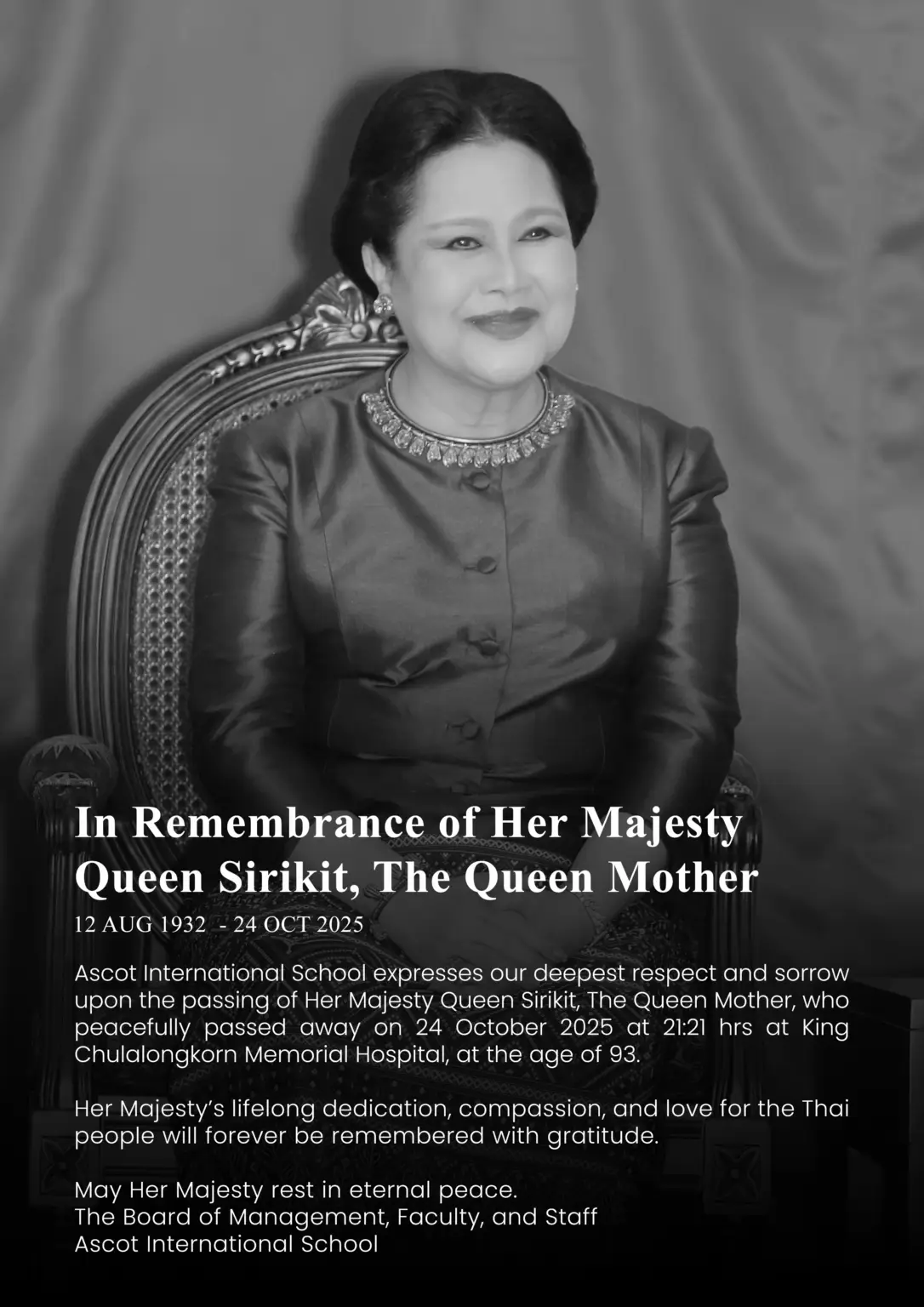
On 24 October 2025, Thailand bid farewell to a beloved figure whose grace and dedication inspired generations. Her Majesty Queen Sirikit, The Queen Mother, passed away peacefully at King Chulalongkorn Memorial Hospital at the age of 93.
Her life was a journey of love, sacrifice, and lifelong service to her people, a story that continues to live in the heart of the nation.
Her Majesty Queen Sirikit dedicated every year of her life to the happiness of her people. She was a true symbol of Thai grace, a queen whose kindness healed, whose leadership inspired, and whose compassion united the nation.
May Her Majesty rest in eternal peace.
May her spirit of generosity, beauty, and service continue to guide Thailand forever.
Her Majesty was born on 12 August 1932 in Bangkok, as Mom Rajawongse Sirikit Kitiyakara, the daughter of Prince Nakkhatra Mangala and Mom Luang Bua Kitiyakara. She spent her early childhood between Bangkok and the provinces, studying at Rajini School and St. Francis Xavier Convent School.
In the late 1940s, when her father was appointed Thai Ambassador to France, she continued her studies in Paris, Copenhagen, and London, where she developed fluency in foreign languages and an appreciation for global culture. This international experience later helped her represent Thailand with confidence and grace.
While in Paris in 1949, she met His Majesty King Bhumibol Adulyadej (Rama IX), who was studying in Switzerland. Their friendship soon deepened into love. On 28 April 1950, they were married in a simple yet deeply meaningful ceremony at Sra Pathum Palace.
A few days later, on 5 May 1950, she stood beside His Majesty during the coronation at the Grand Palace, becoming Queen Consort of Thailand
Throughout the 1950s, Queen Sirikit accompanied the King on numerous visits across the nation, travelling through remote areas by jeep, boat, and sometimes even elephant. She met farmers, fishermen, and villagers, observing their daily lives and struggles.
When the King entered the monkhood in 1956, Her Majesty was appointed Regent of Thailand (22 October – 5 November 1956). This role marked the first time a Thai queen had served as regent in the modern era, a symbol of her leadership and wisdom.
During this period, she also began supporting early vocational training programmes for women and rural families, laying the foundation for her future humanitarian work.
In 1960, Her Majesty accompanied His Majesty on a historic state visit to Europe and the United States, marking Thailand’s return to the global stage. Her poise and charm captivated international audiences and brought worldwide admiration for Thai culture.
Her choice of elegant Thai silk dresses, woven by rural artisans, introduced the beauty of Thai textiles to the world. This led to renewed interest in Thai traditional weaving and inspired future preservation efforts.
During the 1970s, Queen Sirikit frequently travelled to rural communities, particularly in Northeastern and Southern Thailand, where she witnessed poverty and declining traditional crafts.
Seeing this, she began supporting village weaving groups and supplementary occupations that could provide families with additional income. These early efforts grew into a national movement of empowerment and self-reliance.
In 1976, Her Majesty officially founded the Foundation for the Promotion of Supplementary Occupations and Related Techniques, known as the SUPPORT Foundation.
Its main goals were:
By 1978, the foundation’s first training centre opened at Chitralada Villa in Bangkok. Craftsmen and craftswomen were trained in weaving, embroidery, silverwork, pottery, and wood carving. Their creations later became national treasures showcased in museums and exhibitions.
Through SUPPORT, thousands of villagers, especially women were able to earn stable incomes, reduce poverty, and preserve Thai identity.
The 1980s marked a golden era of Her Majesty’s royal work. She established and supported multiple national institutions that continue to serve the Thai people today.
Her Majesty initiated training centres in provinces such as Nan, Surin, Chiang Mai, and Narathiwat to revive regional weaving traditions.
She later established the Arts of the Kingdom Museum, displaying masterpieces created by craftsmen under her patronage.
Her Majesty supported the Children’s Hospital, later renamed the Queen Sirikit National Institute of Child Health (1996), offering modern healthcare for children and families.
She also championed women’s health awareness and launched projects that promoted better living conditions for mothers in rural communities.
Her Majesty recognised the urgent need to protect Thailand’s forests and wildlife. She became patron of reforestation and wildlife protection projects, including campaigns to protect the elephant, Thailand’s national symbol.
She promoted the concept that caring for nature is caring for our children’s future.
In 2004, the Queen Sirikit Centre for Breast Cancer (QSCBC) was established to provide screening and treatment for women, regardless of social status.
Her Majesty’s compassion for cancer patients led to the creation of Pink Park Village, a rehabilitation centre offering care for underprivileged women fighting breast cancer.
Her commitment to Thai arts also resulted in the founding of the Queen Sirikit Museum of Textiles, which officially opened in 2012 within the Grand Palace. The museum showcases both ancient and modern weaving traditions and continues to inspire Thai designers today.
In 2012, Her Majesty suffered an ischemic stroke and gradually retired from public life. Despite this, her foundations and projects continued their mission, guided by the principles she had set.
After the passing of His Majesty King Bhumibol Adulyadej on 13 October 2016, Her Majesty received the title The Queen Mother, symbolising her continued presence as the nation’s spiritual guardian.
In her final years, Her Majesty remained under dedicated medical care while her legacy of service endured through ongoing royal projects.
On 24 October 2025, The Royal Household Bureau announced Her Majesty’s passing. The Thai government declared a year-long period of mourning to honour her extraordinary life and achievements.
Her funeral was marked by deep reverence and reflection, as millions of Thais remembered her as the Mother of the Nation.
Over seven decades, Her Majesty Queen Sirikit transformed compassion into action. Her legacy lives through:
Her contributions reflect her belief that national progress begins with human dignity, cultural pride, and love for nature.


International playgroup in Bangkok at Ascot International School If you

Why entering at this stage works academically and socially Choosing

Year 4 students share Christmas joy with a carol performance